Stop Building Campaigns in the Dark: How HubSpot’s AI Tools Are Changing What’s Possible in 2026
There’s a version of digital marketing that a lot of businesses are still stuck in. You build a landing page, launch a campaign, wait a few weeks, look at the results, and then make adjustments for the next one. It’s the “launch and hope” model – and while it’s familiar, it’s also extraordinarily inefficient.
By the time you’ve gathered enough data to make a meaningful decision, the campaign moment has passed. The audience has moved on. The opportunity was there; you just didn’t have the information quickly enough to act on it.
HubSpot in 2026 is built for a very different way of working. With the combination of a genuinely powerful Content Management System in Content Hub, AI-driven campaign intelligence through Marketing Studio, and Breeze AI’s rapidly expanding suite of tools – including live performance monitoring and intent signal detection – the gap between launching a campaign and understanding how to optimise it has shrunk from weeks to hours, and in some cases, to real time.
This post is about how to take full advantage of that shift – and why the businesses that do will leave those still building campaigns in the dark a very long way behind.
Why Most HubSpot Websites and Campaign Pages Underperform
Before we get into what’s possible, it’s worth being honest about where most businesses are starting from.
The majority of HubSpot websites and landing pages we review during audits were built quickly – often during an implementation sprint when there were a hundred other things competing for attention. They’re functional. They probably looked good on launch day. But they were never properly optimised for search, never tested for conversion, and never connected to the kind of performance intelligence that would allow them to improve over time.
The result is a website that generates a trickle of leads when it should be generating a stream. Campaign landing pages with bounce rates nobody has investigated. Forms that are capturing the wrong information. Blog content that was written for the brand rather than for the audience searching for answers.
None of this is irreversible. But fixing it requires a different approach to how you think about building and managing growth assets – one that treats every page, every campaign, and every piece of content as a living, testable, improvable asset rather than a finished deliverable.
HubSpot Content Hub: Built for Growth, Not Just Publishing
HubSpot rebranded CMS Hub to Content Hub for a reason. It’s no longer just a place to host web pages – it’s a fully integrated content operating system that connects your website, your campaigns, your CRM data, and your AI tools in a single environment.
For growing businesses, this matters enormously. Here’s why:
Everything Lives in One Place When your website, landing pages, blog, forms, CTAs, and email campaigns all live in the same platform as your CRM, something powerful happens: the data connects. A contact who visits your pricing page three times, downloads a guide, and opens two emails is telling you something very specific about their level of intent. In a fragmented tech stack, that story is invisible. In HubSpot Content Hub, it’s a clear signal – one your automations can act on immediately.
Personalisation at Scale Content Hub allows you to serve different content to different audiences based on CRM data. A contact who is already a customer sees a different homepage banner than a prospect who found you through organic search. A lead who has downloaded a specific guide sees a follow-up CTA relevant to their next logical step. This level of personalisation was previously the preserve of enterprise marketing teams with significant development resource. In HubSpot, it’s built in.
Collaboration and Governance for Teams One of the most practical improvements in recent Content Hub updates is the strengthening of team collaboration features – including content approvals, version control, and permission-based editing. For businesses with multiple contributors working on web content, this eliminates the risk of unreviewed changes going live and creates a clear audit trail for every piece of content on your site.
Building for AEO: The Shift You Can’t Afford to Ignore
SEO is not dead. But it is no longer the only game in town – and businesses that are optimising exclusively for traditional search are missing a rapidly growing share of how their potential customers are finding information.
Answer Engine Optimisation (AEO) is the practice of structuring your content to appear as direct answers in AI-powered search tools – including Google’s AI Overviews, Perplexity, ChatGPT search, and Microsoft Copilot. These tools don’t send users to a list of results and ask them to choose. They synthesise an answer – and either your content contributes to that answer, or it doesn’t.
The difference between content that ranks in traditional search and content that gets pulled into AI-generated answers comes down to a few key principles:
Answer specific questions directly. AI search engines are looking for content that clearly and concisely answers the question being asked. Structure your content around real questions – the ones your target audience is actually typing or speaking – and answer them unambiguously in the opening sentences of each section.
Use clear heading structures. H2 and H3 headings that read like questions or direct topic statements are far more likely to be indexed as discrete answers than paragraphs of flowing prose. This isn’t just good practice – it’s the structural signal that tells AI engines exactly what each section of your content is about.
Demonstrate expertise and specificity. Generic content that could apply to anyone gets deprioritised by both traditional search algorithms and AI engines. Specific, expert content that addresses a clearly defined problem for a clearly defined audience performs significantly better – and builds the kind of topical authority that compounds over time.
Keep it current. AI engines favour fresh, recently updated content. A blog post from 2022 that hasn’t been reviewed since is unlikely to surface as an authoritative answer in 2026. Building a content refresh cadence into your marketing calendar is now a genuine competitive necessity.
HubSpot Content Hub supports all of these practices natively – with built-in SEO recommendations, content performance tracking, and the ability to update and republish content without losing historical analytics data.
Breeze AI: Understanding What Your Audience Actually Wants
One of the most significant shifts in HubSpot’s AI capabilities is the move from reactive to predictive intelligence. Breeze AI – HubSpot’s suite of AI tools embedded across the platform – now includes intent signal detection that analyses behaviour across your CRM, your website, and your campaigns to surface insights about what your audience is actually looking for.
In practical terms, this means you can:
Identify which topics and content types are generating the strongest engagement signals from your highest-value contacts
Understand which stage of the buying journey specific audience segments are in – based on behavioural data rather than assumptions
Receive AI-generated content recommendations that reflect what your specific audience is responding to, not just generic best practice
For content strategy, this is genuinely transformative. Rather than deciding what to write about based on keyword volumes alone, you’re making decisions informed by real signals from your real audience – the people who are already in your CRM and engaging with your brand.
Breeze AI’s Copilot assistant also now supports content drafting, headline testing, and CTA optimisation directly within Content Hub – meaning your team can iterate on campaign assets without switching between platforms or waiting for external support.
Marketing Studio: Where Campaign Intelligence Gets Real
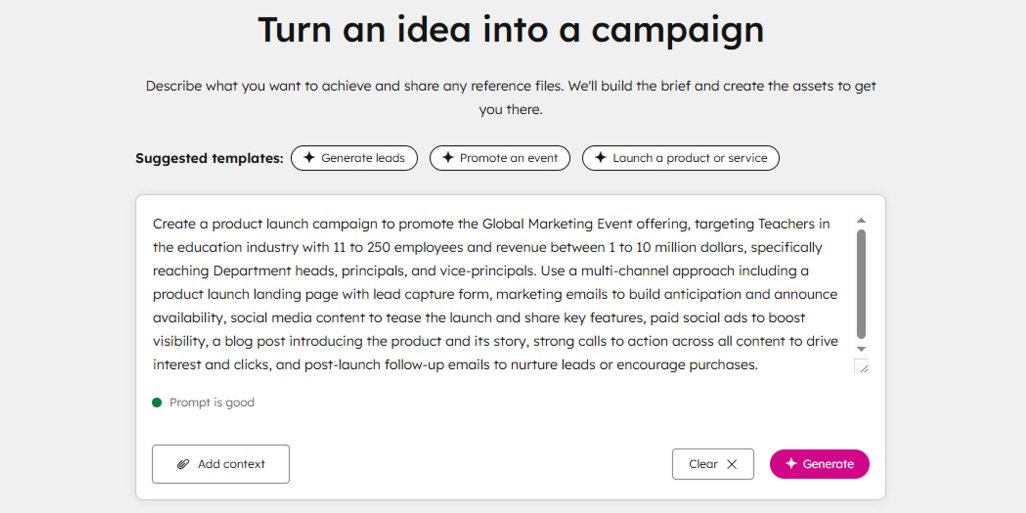
If there’s one HubSpot capability that deserves far more attention than it typically gets, it’s Marketing Studio – HubSpot’s centralised command centre for managing, monitoring, and optimising campaigns in real time.
Marketing Studio brings together your email campaigns, paid ads, social posts, landing pages, and workflows into a single unified view – and layers AI-powered performance intelligence on top of it. Rather than jumping between individual campaign reports to piece together a picture of what’s working, you can see the full performance story of any campaign or channel in one place.
Live Performance Monitoring This is where the real operational value lies. Marketing Studio’s live monitoring capability means you’re no longer waiting for a weekly report to discover that an email campaign has an unusually high bounce rate, or that a landing page is generating traffic but converting at half the expected rate.
You can see performance as it happens. And more importantly, HubSpot’s AI layer is watching it with you – flagging anomalies, surfacing patterns, and in some cases suggesting specific optimisations based on what it’s observing across your campaigns and historical performance data.
For a marketing team running multiple campaigns simultaneously, this changes the entire operational model. Issues that would previously go unnoticed for days – a broken form link, a workflow triggering for the wrong segment, a paid ad campaign with a soaring cost per click – are surfaced immediately. The team can respond while the campaign is still running, rather than conducting a post-mortem after the budget has been spent.
AI-Assisted Campaign Optimisation Beyond monitoring, Marketing Studio is increasingly becoming a source of proactive recommendations. HubSpot’s AI tools can now suggest the optimal send time for email campaigns based on your specific audience’s historical engagement patterns – not industry averages, but your audience’s actual behaviour.
Subject line performance, CTA click-through rates, form completion rates – all of these are being analysed continuously, and the insights fed back into the campaign management interface in a way that makes acting on them straightforward rather than technical.
For teams without a dedicated data analyst, this represents a genuine democratisation of campaign intelligence. The kind of insight that previously required specialist skills to surface and interpret is now available directly in the platform – in plain language, with clear recommended actions.
The New “Run Agent” Workflow Action One of the most exciting developments in HubSpot’s AI roadmap is the “Run Agent” workflow action, currently in private beta. This allows Breeze AI agents to be triggered automatically as part of any HubSpot workflow – meaning AI-powered actions can be built into your campaign and CRM automations at the point of need.
The implications for campaign management are significant. Imagine a workflow that automatically reviews a new contact’s engagement history, assesses their intent signals, and assigns them to the most relevant nurture track – without any human intervention required. Or a post-campaign workflow that triggers an AI review of performance data and generates a summary report with recommendations.
This is the direction HubSpot is moving in – and it’s moving quickly. Businesses that are building their HubSpot setup with this capability in mind will be significantly better positioned to adopt it as it moves from beta to general availability.
What Great Growth Assets Look Like in Practice
Let’s bring this out of the abstract and into something concrete. When Hub Genies works with clients on growth assets and CMS strategy, here’s what we’re typically building:
Campaign Landing Pages That Convert Not just visually appealing pages – pages that are structured specifically around conversion. That means a single, clear call to action. A headline that speaks directly to the visitor’s problem. Social proof in the right place. A form that asks only for the information you actually need. And page speed optimised to meet Google’s Core Web Vitals thresholds, because a beautiful page that loads slowly will lose visitors before they’ve read a word.
Every landing page we build is connected to a HubSpot campaign – so performance data flows back into your reporting automatically, and attribution is clear from day one.
SEO and AEO-Optimised Blog Content Blog content that is structured to rank in traditional search and to surface in AI-generated answers. This means thorough keyword and intent research upfront, content structured around real questions, expert positioning that builds topical authority, and a refresh strategy that keeps the content current over time.
We also build content pillars – comprehensive, authoritative hub pages on your core topics that link to and from supporting blog content – because topical authority is increasingly how both traditional search algorithms and AI engines assess credibility.
Gated Assets and the Content Library Guides, templates, checklists, and reports that sit behind a form – and are connected to your CRM so that every download enriches the contact record and can trigger relevant follow-up. HubSpot’s Content Library feature allows you to manage and personalise gated content delivery based on what you already know about the contact, which significantly improves both the user experience and the quality of the engagement data you collect.
Pillar Pages for AEO Long-form, authoritative pages structured around a core topic that your target audience is actively searching for – and written specifically to be picked up as a source by AI search engines. These are among the highest-value assets we build for clients, because they compound in value over time and establish genuine topical authority that supports every other piece of content you produce.
The Compounding Value of Getting This Right Here’s the thing about growth assets: unlike paid advertising, the value doesn’t disappear when you stop spending. A well-built landing page, a well-structured blog post, a well-designed content hub – these continue to generate traffic, leads, and revenue long after they were created, as long as they’re maintained and kept current.
The businesses that invest in building high-quality, well-optimised growth assets on HubSpot Content Hub – and in the AI-powered campaign intelligence that Marketing Studio and Breeze now provide – are building a compounding asset. Every piece of content that ranks, every campaign that improves through live monitoring, every insight that informs a better decision – these compound over time into a marketing engine that gets more effective the longer it runs.
That’s a fundamentally different model to renting attention through paid advertising. And in a world where AI is transforming how people find information and make purchasing decisions, it’s increasingly the model that determines who wins.
The Bottom Line
HubSpot Content Hub, Marketing Studio, and Breeze AI together represent the most powerful set of tools a growing business has ever had access to for building, running, and optimising campaigns. But like every tool, their value is entirely dependent on how well they’re set up, how thoughtfully the strategy behind them is designed, and how consistently the team using them is supported.
If your HubSpot website feels like a digital brochure rather than a growth engine – or if your campaigns are still operating on the “launch and hope” model – the capability to change that is already in your platform. You just need the right strategy and the right support to unlock it.
That’s exactly what Hub Genies helps with. From content strategy and AEO optimisation to Marketing Studio setup and Breeze AI integration, we help you build the assets and the intelligence layer that turns HubSpot into a genuine competitive advantage.
Want to see what your HubSpot growth potential really looks like? Book a Content and Campaign Strategy session with Hub Genies – we’ll audit what you have, identify the gaps, and map out exactly what to build next.